
Lessons of Yarrow


I first encountered David Yarrow’s photography in a turbo-douchey ski resort in Montana. His art adorned the entirety of the classic American five-star western hotel I found myself in—big gas fireplaces, overpriced restaurants, staff who offer to put your boots on for you, and the type of tourists who travel with both kids and nannies in tow. The perfect setting for a Yarrow.
I don’t like David Yarrow’s work. In fact, when I encountered it in this hotel a few years ago, a friend and I found it so laughably gauche that we made cohabitating with a Yarrow table stakes for a bet; the loser would have to put up a large Yarrow1 and earnestly explain to their live-in girlfriend that they found a black-and-white photo of a wolf and a girl and a car the best decor choice for a lower Manhattan apartment.
For the unfamiliar, most Yarrow photos have three key elements: a snowy ski town setting, a supermodel in some state of undress, and a wild animal. He collaborates with celebrities, some of whom appear in the photos—a recreation of trading floor scenes from the Wolf of Wall Street featuring the real Jordan Belfort, John McEnroe outside a bar in Jackson Hole, and of course, girls in every picture—supermodels like Cara Delevingne and Brooks Nader. His pieces are shallow, and I hesitate to call them art at all, because I do not believe anyone finds much deeper meaning in a Yarrow. As soon as you see them, you have internalized their point—a Western train robbery, a model with her tits out in a vintage Porsche, a trained wolf in the passenger seat. Straussian art smuggles in a controversial message by way of requiring advanced pattern-matching to decode it; Yarrowian art kicks you right in the balls with the message, and whether you have an art degree or a math phd or Down’s syndrome you will have received it just the same. People get the same thrill from viewing a Yarrow as from watching porn, or going to the zoo, or making their kids sit through Butch Cassidy and the Sundance Kid—and not to denigrate any of these pastimes, but none have much in common with the experience of seeing Michelangelo’s David or the Sistine Chapel.
My sneering denigration of and ungentlemanly bet regarding these photos years ago notwithstanding, today David Yarrow is one of the most popular fine artists on Earth. If you go to any high-end ski town in America, you will find galleries dedicating their entire space to his work. Artsy, an art reselling website, lists David Yarrow as their tenth-most searched artist, rounding out a top ten list that includes Warhol, Basquiat, and Picasso. No longer confined to Jackson Hole, Aspen, and Vail—though utterly dominant of their respective art galleries—you can see a Yarrow exhibit in New York or London. His work ranges in price from the high five to high six figures per piece, and the pieces are numerous.
As I strode through yet another Yarrow exhibit in a different turbo-douche ski town (this time in Colorado) last week, I wondered if my initial assessment missed something. After all, I do like a lot of famous and popular art—who doesn’t enjoy The Great Gatsby? And it is doubtful indeed that I would ever even set eyes upon that text had worldly popularity not foisted it upon me. Schopenhauer and Nietzsche thought they knew better than everyone and that popularity itself might be a sign of bad art, but they died sad and alone. So what’s in a Yarrow?
David Yarrow was not always a photographer, but he started out as one. As a young man, he captured a famous moment of Diego Maradona following Argentina’s World Cup victory in the 80s—though upon further inspection, you’ll find there were several photos of that moment, only one of which was Yarrow’s. He is clearly technically skilled at his craft, and a very competent and clever man, so skilled that he went into investment banking after university and founded a hedge fund in 1995. He was never a smashing success in hedge fund world, with his fund never reaching a billion, but he did have quite a few good years, and no one should doubt that Yarrow reaped rewards in the tens of millions. His art is a second act, though he continued to publish wildlife photography throughout his hedge fund days.
You could be forgiven for having a rather dim composite of this individual: a divorced British financier lecherously photographing younger women and cool cars and animals in wealthiest towns of the American West. And I’m not sure this is entirely wrong. But there is something positive about a Yarrow that is undeniable, and that is completely missing from the modern art scene; his optimism slakes a thirst that has parched American art for decades.
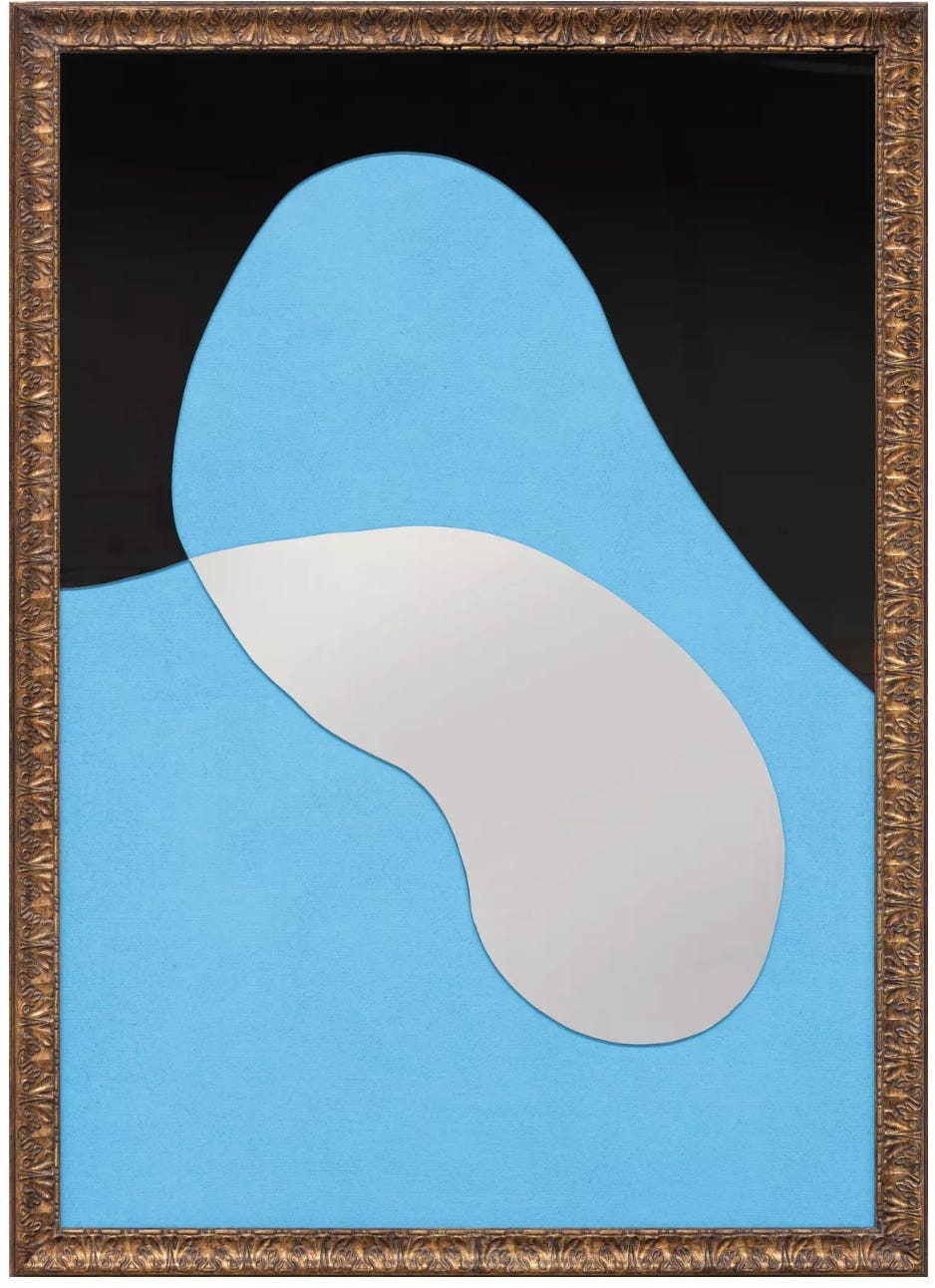
Art that is simultaneously positive and celebratory, unapologetic, beautiful, and executed with technical skill is almost impossible to find. Walk into any art gallery on Sullivan Street and you will be confronted with two primary categories of art.2 First, there is what I call “wallpaper art.” Wallpaper art is typically abstract, but unlike (say) abstract expressionism, or even the bold strokes and color of a Rothko, it evokes nothing beyond general pleasantness and good taste. Rich people do not typically buy these themselves, but rather give a fat budget to their interior designer and send them to the galleries, since they’re busy coding AI agents or doing private equity deals or whatever. Said designer then goes through his patronage networks and wastes a fucking absurd six to seven figure amount of money on bland and unremarkable art that is sure not to offend the rich person or his guests.3 I am fairly convinced that the selection of wallpaper art that makes it into New York art galleries is primarily determined by who has been willing to play an extremely sleazy “networking” game with the owners of said galleries, and there is nothing special about the art in any way. Here are a few examples of wallpaper art4:


The other type of popular, contemporary art is what I call “art that looks like shit.” ATLLS is a big tent, including artists who are just obviously grifting off one thing over and over (think those weird monopoly men that are in every single gallery in London and New York), to the “tragic immigrants journey” trying to make a leftist political point by painting in period blood or whatever. Neither look remotely good. No, spray-painting dollar signs onto an oil painting of Donald Duck isn’t art, and yes I get that its a critique of consumerism or whatever but it is so, so tired at this point to make something ugly and pretend its subversive, and then sell it for five figgies in a neighborhood where a one-bedroom walkup rents for $5k/month. No, shoving a paintbrush up your ass instead of holding it in your hand isn’t a new movement, it’s just pathological.5 Find a new artist who isn’t Basquiat to knock off, please! A few examples of ATLLS:

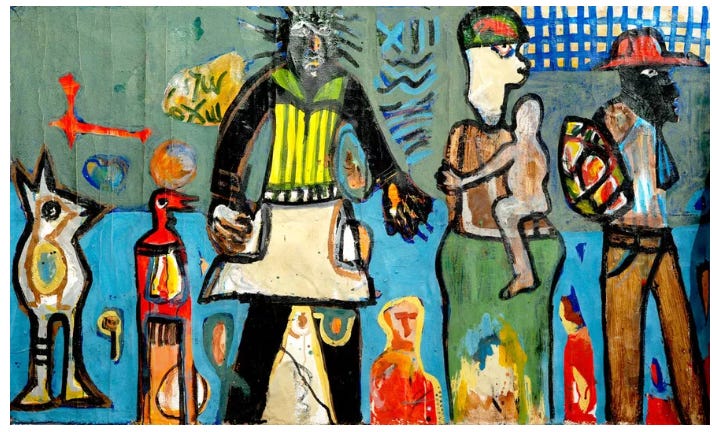
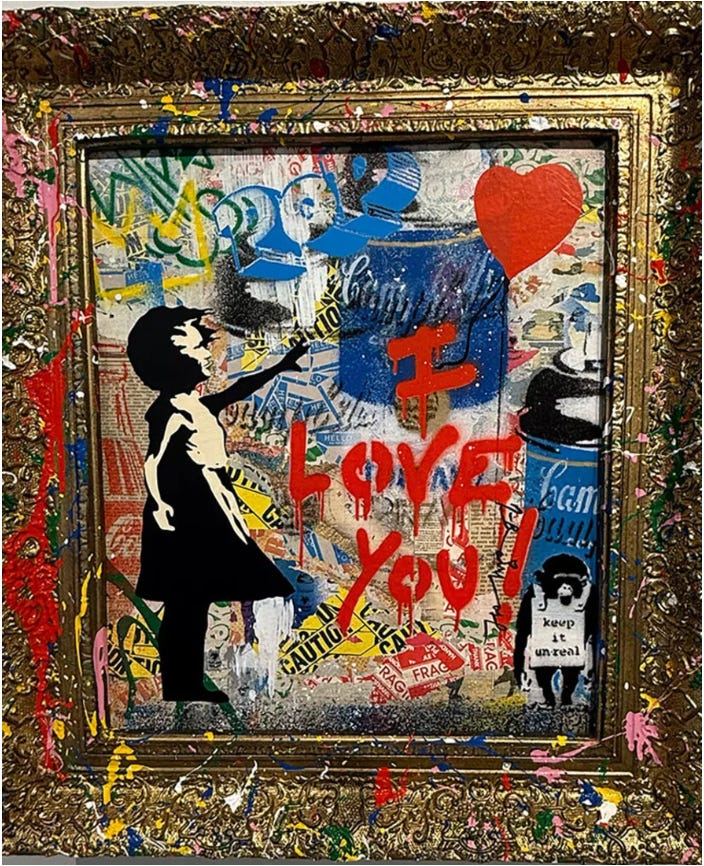
Having said that, I am somewhat sympathetic to ATLLS. I can imagine in a bygone era, when every man wore a suit every day no matter what, when you couldn’t talk about anything the least bit personal or sensitive for fear of seeming vulgar, when decency laws governed artistic expression, it probably was subversive to put out something raw and ugly, as a fuck you to the powers that governed society. I get it. But today, the idea that society needs more uglification, that the old bonds between neighbors and churches and families are too strong rather than not strong enough, is absurd on its face. It is obvious to most everyone living in America that society is atomized, that people are lonely, desperate for something to look up to and bind them together in the absence of religion and patriotism.
Back to Yarrow. Say what you want about Yarrow’s art, it is in neither of these two categories. It is triumphant and nostalgic. It does not apologize for the American Western aesthetic, but instead glorifies it with high production value staged scenes and beautiful women. It is not tragic—to create art that evokes tragedy is easy, because death and misery are profoundly emotional topics latent in every viewer. It is far harder to make a viewer feel something without reaching for the extraordinarily brutal or cruel. Yarrow’s work is intended to fill his readers with awe, of the wild spirit of the West, with a lust for life and adventure, even if I find it sensationalist and stylized. It is very hard to find triumphalist art in 2025, but it is a very human impulse to seek it, and so I am unsurprised that the rich people who buy art in galleries have elevated Yarrow to celebrity status.
There is one final message I take from Yarrow’s art: cringe is good. He was a random financial professional who started taking pictures. Can you imagine the fucking stones on this guy to pitch a scantily-clad Cindy Crawford with a red convertible and two wolves? I don’t even think I could get the words out, I would pass out from embarrassment first. But he had a positive vision and executed on it, and has left his mark on the global art scene in a way even he could not have envisioned from the start. I think this is related to the lack of triumphalism in modern art—to elevate something instead of denigrate, sneer and deconstruct takes courage, it risks being laughed at and mocked. But people want something positive. Deconstructing things others have built has been done to death, beaten into the ground, and today the deconstructors have won such a total victory that it is building which is cool and subversive. So you should build your vision, execute competently and with passion and who knows—maybe the rest will follow.6
I still don’t like David Yarrow’s art. But I will give him credit. He took a risk, built something beautiful, and people loved it. We could all learn a thing or two from Mr. Yarrow.

A print, that is. No one involved has original Yarrow money for stupid bets between friends.
I started collecting art a few years ago and this is my impression of the modern art world—however bleak a Yarrow might be, the “art gallery scene” is worse.
Don’t feel bad at all for the rich people doing this. They have no taste or opinions, but they want something “nice,” and the only means of evaluating the art available to them is the price tag. So if the interior decorator brought back art that cost less money, they would actually be upset.
To be clear, I think a lot of these pieces of art look really nice! I just don’t think they’re existentially interesting the way art should be. People seem to love Agnes Martin, so maybe I just don’t get it—but I don’t get it.
These are all real things that I have seen in galleries, I’m not making them up.
Here I am talking to myself as much as anyone else.